
A reader searches 'gaming' and meets two unrelated senses
Type "gaming" into a search bar and two completely separate worlds answer. One is about playing video games — consoles, PCs, phones, the culture around them. The other is a legal and industry term for gambling: casinos, betting operators, and the regulatory bodies that license them use "gaming" as their formal word for wagering. Wikipedia's entry on gaming treats the video-game sense as the primary one but flags the gambling usage as a distinct, older meaning that survives in law and industry names.
The two senses don't overlap in practice. A "gaming commission" regulates casinos, not consoles. A "gaming laptop" has nothing to do with slot machines. If a headline, a state agency, or a company name uses "gaming" and the context is licensing, wagering, or casino floors, it's the gambling sense; if the context is consoles, PCs, or game reviews, it's the video-game sense. Knowing which is meant before reading further saves a reader from misreading an entire article.
A player wants to play a specific title
A player who wants to play a specific title first needs a platform that can run it. Most titles are tied to one of three routes: a console such as Nintendo Switch or Xbox, a personal computer, or a cloud streaming service that runs the game on a remote server and sends video back to a device.
Cloud gaming removes the up-front hardware purchase but replaces it with a different requirement: a stable, reasonably fast broadband connection with low enough latency that button presses don't visibly lag behind on-screen action. That trade is real — no local console or GPU to buy — but it only works if the household connection can sustain it, which is a check most console buyers never have to make.
The practical decision comes down to what's already true of a household, not which platform is "best":
- Own a TV and want simplicity: a console like Nintendo Switch or Xbox is a one-time purchase with no ongoing connection dependency once the game is downloaded.
- Already have a capable PC: no extra hardware needed, plus access to titles that never reach consoles.
- Have strong, low-latency broadband but no gaming hardware: cloud gaming lets a phone or basic laptop run demanding titles, at the cost of depending on that connection every session.
A title is announced with a release date and sometimes a limited edition
A title's release date is announced well before the game is playable, and pre-release coverage fills that gap with trailers, previews, and speculation rather than verified quality. Blood Dawnwalker is a current example: it has generated ongoing pre-release coverage as an unreleased action title, but that coverage is necessarily about expectation, not about how the finished game performs.
Publishers sometimes pair a release date with a limited edition — a restricted print run bundled with extra items, tied to the release window and usually available only through preorder. None of that changes when actual quality evidence arrives: a review published once a title has shipped is the first point where performance, bugs, and design choices are assessed against a finished build rather than a trailer.
That timing splits buyers into two different trades. Preordering a limited edition locks in bonus content and guards against a print run selling out, at the cost of paying before any review exists. Waiting for launch-week reviews costs the limited-edition bonus but replaces hype-stage coverage with actual evidence before money changes hands.
Long uninterrupted sessions are the mechanism behind most claimed harms of gaming
Most of what gets blamed on "gaming" as a health concern isn't caused by the activity itself — it's caused by how long a session runs and what it displaces. Reported harms tend to trace back to extended, uninterrupted play cutting into sleep, physical activity, or in-person contact, rather than to the presence of a controller or screen as such.
That reframes the health question. It isn't "is gaming healthy," which has no single answer, but "how much, how continuously, and at whose expense" — a question about session length and what's being displaced, which a reader can actually act on by managing breaks and total time rather than by avoiding games altogether.
Nintendo Switch
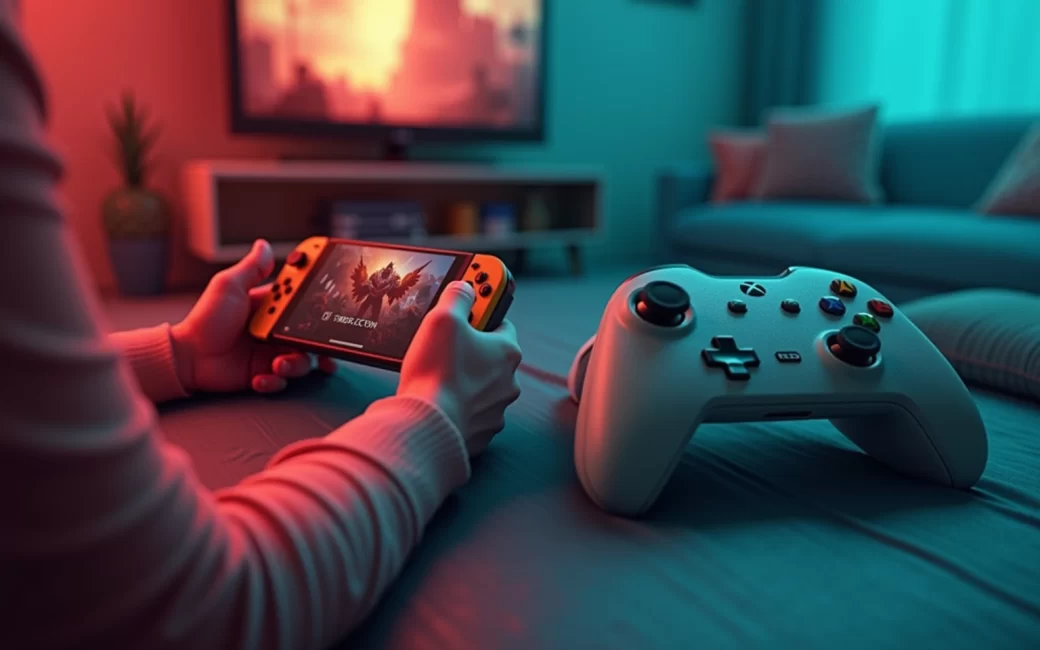
Nintendo Switch works as both a home console docked to a TV and a handheld undocked, and that dual form factor is its defining trait. It gets recommended for households that want one purchase to cover both a living-room screen and portable play, without the ongoing connection dependency that cloud gaming carries.
Xbox
Xbox is Microsoft's console family, built around a stronger tie to PC-style hardware than a Switch offers, along with cross-play and shared libraries with Windows machines. That matters to a buyer who already owns a Windows PC and wants saves and purchases to carry over between the two rather than living in separate ecosystems.
Cloud gaming
Cloud gaming runs a game on a remote server and streams the video output to whatever screen a player has, instead of requiring the game to run on local hardware. The requirement that makes or breaks it is a connection fast and stable enough to keep input lag low — the single factor that determines whether the experience is usable at all, and one that has nothing to do with which console or PC a household already owns.
Blood Dawnwalker
Blood Dawnwalker is an unreleased action title built around vampire-hunting combat, and coverage of it so far consists of trailers, setting details, and speculation rather than any finished build a reviewer has played. That gap between announcement and launch is normal for a title still building pre-release attention — what's published now is about expectation, not confirmed performance, and stays that way until a review of the shipped game exists.
Video game
A video game is the object underneath nearly all of this: a program a player interacts with through inputs, on a console, PC, phone, or cloud stream, with a review of the finished build serving as the closest thing to a quality measurement it gets. Everything else — platform, release date, limited edition, health debate — orbits that core object rather than replacing it, which is why "game" is the word doing the work in almost every piece of coverage on the topic even when "gaming" is the word doing the searching.
Who started gaming?
Video games predate home consoles by decades: early computer scientists built playable programs on lab machines in the 1950s and 60s, well before "gaming" meant a consumer product. Wikipedia's account of the medium's history traces the shift from those research demonstrations to arcade cabinets and then home systems as the point where gaming became something the public bought rather than something researchers built to test hardware.
That trajectory matters for how the word is used today: "gaming" as a mass activity is a later, commercial layer on top of an older technical one, which is also why the console, PC, and cloud routes covered above are all comparatively recent compared to the medium's origin.
Do gamers make money?
Some players earn money from games, through three broad routes that pay very differently. Competitive players can win prize money at tournaments for specific titles; streamers and video creators earn from platform payouts, subscriptions, and sponsorships tied to an audience they've built; and a smaller group works inside the industry itself, in roles from game testing to community management, where the pay is a wage rather than a prize or an audience-driven income. None of these routes is available just from owning a console or a PC — each depends on a specific skill, audience, or job separate from playing for its own sake, and none is guaranteed by spending time in a game the way session length or platform choice is.
What is the definition of gaming?
Gaming, in the sense most searches for the word intend, means playing games — overwhelmingly video games — along with the culture, industry and coverage that surrounds that play. Wikipedia's gaming entry treats this as the primary modern sense, while noting the separate, older use of "gaming" as a formal term for gambling in law and casino regulation.
Under that primary sense, gaming covers console play on Nintendo Switch or Xbox, PC play, and cloud streaming, plus the surrounding ecosystem of release dates, limited editions, and reviews that current outlets such as Polygon and wccftech report on continuously. The gambling sense is narrower and mostly confined to legal and regulatory contexts, so a reader who sees "gaming" outside a casino or licensing context can safely read it as video games.
Next, matching a specific title to a platform already owned — or a connection already fast enough for cloud streaming — settles the only real gaming decision most readers came here to make.